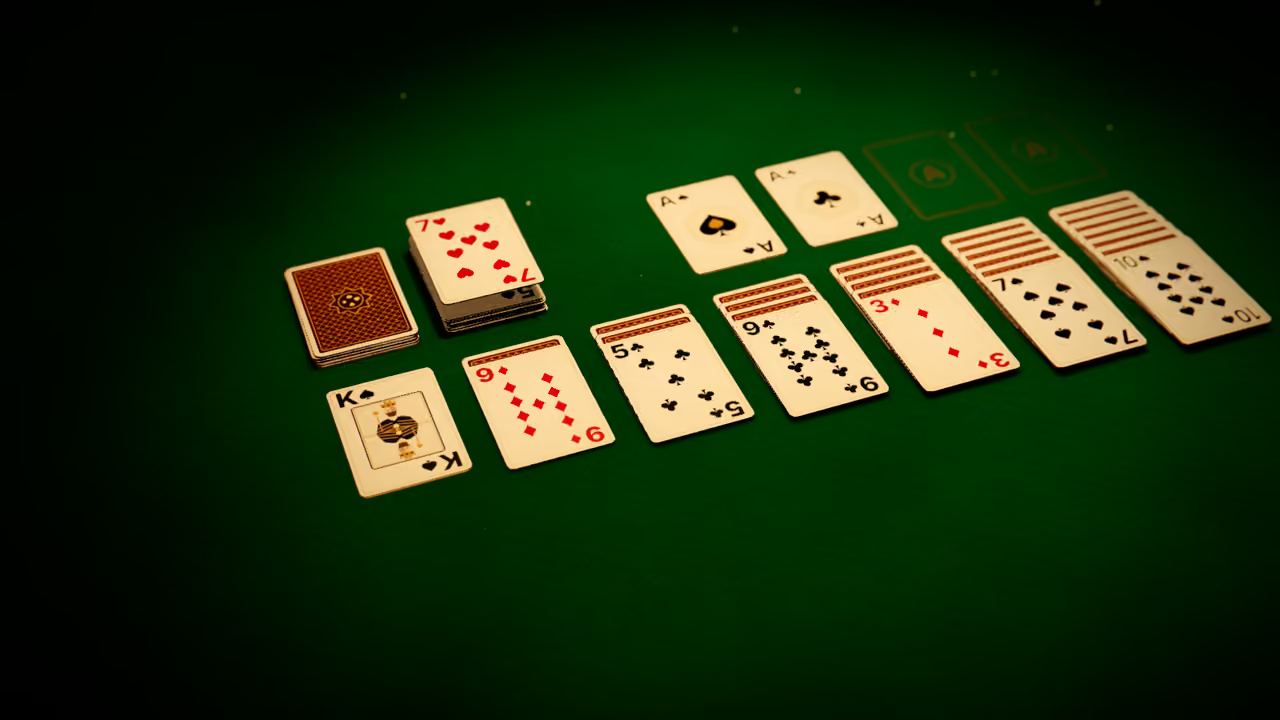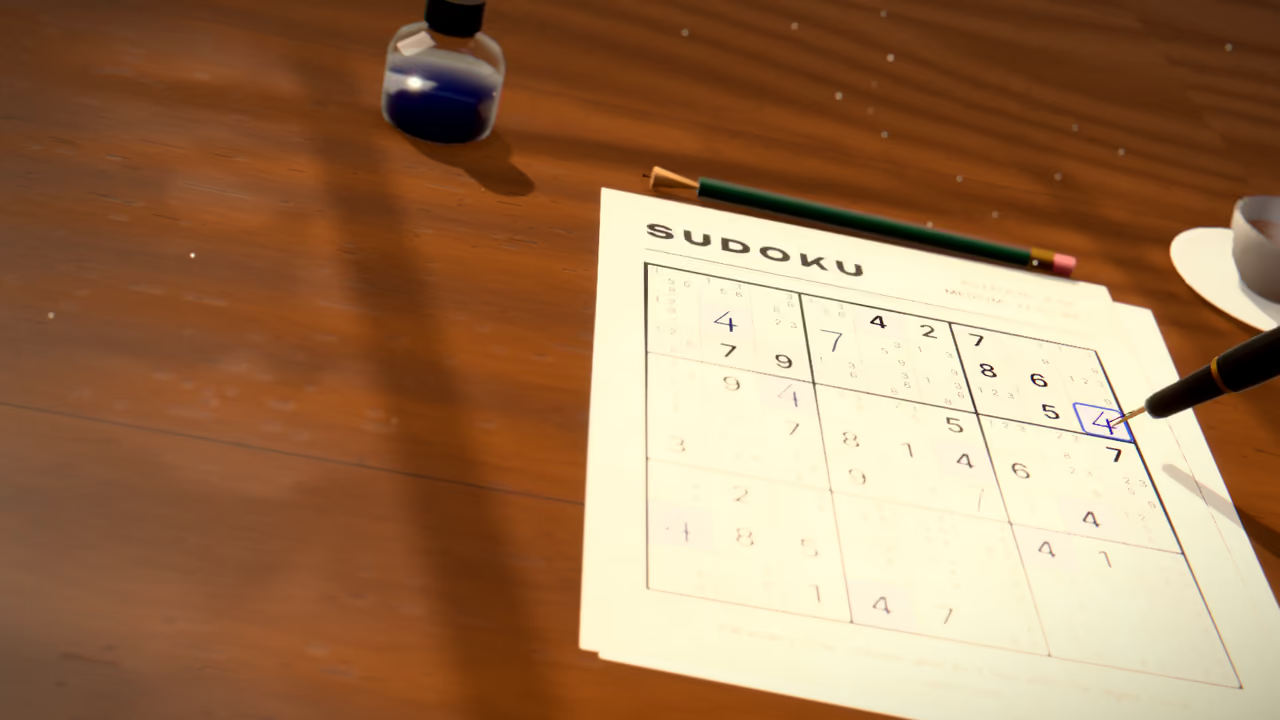
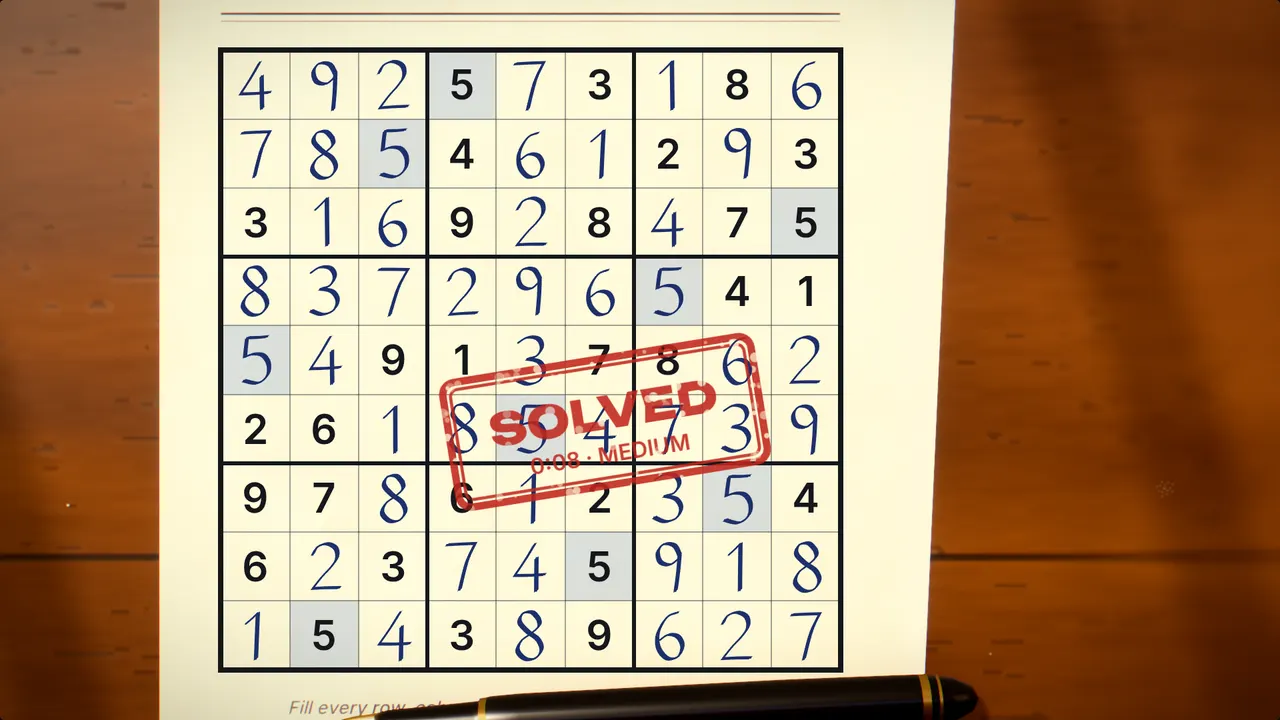
Calm, classic number logic in fountain-pen ink on a sunlit desk.
Sudoku is the number puzzle that needs no maths at all: a 9×9 grid split into nine 3×3 boxes, a handful of digits already printed in, and one rule. Every row, every column and every box must contain the digits 1 to 9 exactly once. Work out where each missing digit has to go, one square at a time, until the page is full.
Every puzzle here is generated fresh and checked to have exactly one solution, so it can always be solved by reasoning alone, never by guessing. Each one is graded by the hardest technique it actually requires: Easy needs nothing but singles, Medium adds pairs, triples and pointing, Hard brings X-Wings, Swordfish and XY-Wings, and Expert asks for colouring, XYZ-Wings, W-Wings and unique rectangles. The Daily Puzzle is the same page for everyone today, gentle on Monday and toughest on Saturday.
How to play
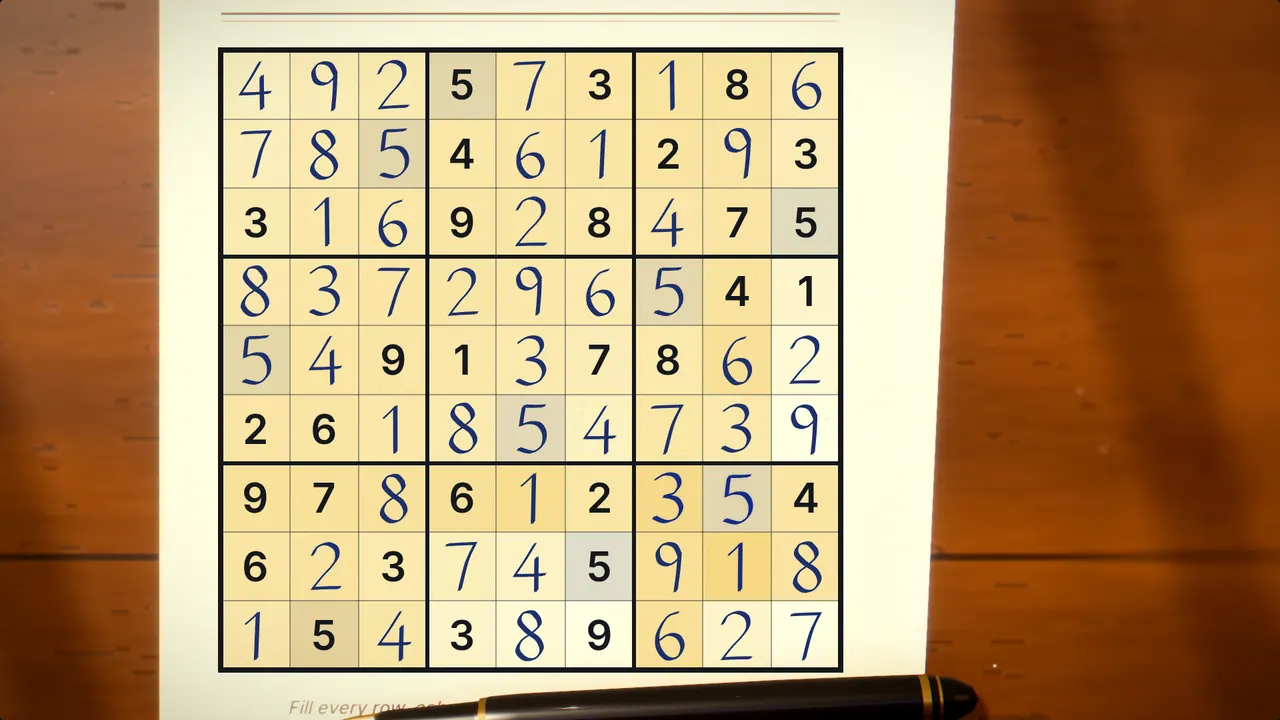
- Select a square by clicking or tapping it, or move with the arrow keys. Type a digit (or tap one on the number pad) to write it in ink. Digits printed in black are the puzzle's givens and can't be changed.
- Use pencil marks to keep track of possibilities. Hold Shift while typing for corner marks, hold Ctrl or Alt for centre marks, or press N (or the pencil button) to switch the pad between ink, corner and centre notes. F fills in every candidate for you. Writing a digit in ink clears it from the notes of every square it can see.
- Selecting a square lightly shades its row, column and box, and highlights every copy of the same digit (including matching pencil marks), which makes scanning much faster. Duplicate digits in a row, column or box are always shaded red. With Check on, a digit that disagrees with the solution is also circled in red; turn Check off for a pure, no-help solve.
- Undo is unlimited (U, Z or Ctrl+Z; Shift+Z or Y to redo). Stuck? Press H or the bulb for a hint that names the technique and explains exactly why the next digit must go where it goes. Each hint adds 30 seconds to your time; press it again to have the digit written in for you.
- Your score is your finishing time: lower is better, and only completed puzzles count. Progress is saved as you go, so you can close the tab and pick up the same page later.
Controls
| Action | Keyboard | Touch | Gamepad |
|---|---|---|---|
| Select a square | Arrow keys or click | Tap a square (drag to move) | D-pad / left stick |
| Write a digit | 1–9 | Number pad | LB / RB choose, A writes |
| Corner / centre notes | Shift+digit / Ctrl or Alt+digit | Pencil button, then the number pad | X cycles notes mode |
| Notes mode (ink → corner → centre) | N or Space | Pencil button | X |
| Erase | Backspace, Delete or 0 | Eraser button | B |
| Undo / redo | U, Z or Ctrl+Z / Y or Shift+Z | Undo button | LT / RT |
| Hint (explains the technique) | H | Bulb button | Y |
| Fill all notes / toggle mistake check | F / M | Auto / Check buttons | — |
| Pause / restart | Esc / R | Pause button | Start / Back |
Every action can be remapped in Settings.
Modes
- Easy
- Singles only: every step is a square with one possible digit.
- Medium
- Needs pairs, triples and pointing / claiming.
- Hard
- Needs X-Wings, Swordfish, XY-Wings or quads.
- Expert
- Needs colouring, XYZ-Wings, W-Wings or unique rectangles.
- Daily Puzzle Daily
- Today's puzzle, the same for everyone. Difficulty changes through the week.
Tips & strategy
- Start with hidden singles in the boxes: pick a digit, look at a box that is missing it, and see which squares are ruled out by the same digit in crossing rows and columns. Often only one square is left.
- Scan by digit, not by square. Selecting any copy of a digit highlights all of them, so the gaps where that digit can still go jump out.
- Pencil marks pay off from Medium upward. Fill them in (F does it instantly), then hunt for pairs: two squares in a unit that can only be the same two digits lock those digits out of the rest of the unit.
- Pointing: if every possible spot for a digit inside a box lies on one row or column, that digit can be removed from the rest of that row or column. Claiming is the same idea the other way round.
- An X-Wing is two rows where a digit fits only in the same two columns. One of each diagonal must hold it, so the digit can be removed from those columns everywhere else.
- Turn Check off once you're confident. Mistakes then cost you nothing until the end, but the No Safety Net achievement needs a Hard or Expert solve without checking or hints.
- Hints cost 30 seconds, but they teach: each one names the technique it used and walks through the reasoning, so reading them is the fastest way to learn the harder patterns.
Achievements
- First InkSolve your first puzzleLocked
- Pairs and PointersSolve a Medium puzzleLocked
- Steady HandSolve a Hard puzzleLocked
- GrandmasterSolve an Expert puzzleLocked
- Daily RitualComplete a Daily PuzzleLocked
- Clean SheetSolve a Medium or harder puzzle with no mistakes and no hintsLocked
- No Safety NetSolve a Hard or Expert puzzle with mistake checking off and no hintsLocked
- Speed ReaderSolve an Easy puzzle in under 4 minutesLocked
- Quick StudySolve a Hard puzzle in under 12 minutesLocked
A short history of the genre
Number-placement puzzles have roots in the Latin squares studied by the mathematician Leonhard Euler in the 18th century, and in French newspaper puzzles of the 1890s that used magic-square ideas. The modern form, with nine 3×3 boxes and printed clues, was published in an American puzzle magazine in 1979 under the name Number Place.
A Japanese publisher brought it home in the 1980s, adding the rule that the clues should be symmetrical and giving it the short name the world now uses. It became a global craze in 2004–2005 after British newspapers started printing it daily, and today it is one of the most-played puzzles on the planet. Serious solvers catalogue dozens of named techniques, from simple singles to fish, wings and chains, and grading puzzles by the techniques they require is how puzzle books separate a gentle Monday from a fiendish weekend.
FAQ
Is this Sudoku free?
Yes. It is free to play in your browser with no download or sign-up. The site is supported by unobtrusive ads that never cover the puzzle.
Does every puzzle have exactly one solution?
Yes. Each puzzle is generated and then checked by a solver that counts solutions; anything with more than one is rejected. Every page can be finished by logic alone, without guessing.
How are the difficulty levels decided?
A human-style solver works through each puzzle, always using the easiest technique available. The hardest technique it needed sets the grade: singles for Easy; pointing, claiming, pairs and triples for Medium; X-Wing, Swordfish, XY-Wing and quads for Hard; colouring, XYZ-Wing, W-Wing, unique rectangles and Jellyfish for Expert.
What is the Daily Puzzle?
One puzzle per day that is the same for every player. It follows the week: easy on Monday, medium on Tuesday, Wednesday and Sunday, hard on Thursday and Friday, and expert on Saturday. Share your time and box-by-box summary when you finish.
Do hints or mistakes affect my time?
Each hint adds 30 seconds. Mistakes don't add time, but with Check on they are shown immediately, which is a big help, so purists turn Check off.
Can I take notes?
Yes: corner marks (Shift+digit), centre marks (Ctrl or Alt+digit) or the pencil button on touch screens. F fills in every candidate, and writing a digit clears it from the notes it can see.
Does it work on phones?
Yes, portrait or landscape. Tap a square, then a number. The grid is drawn at your screen's full resolution so it stays sharp and readable on any device.
Will I lose my progress if I close the page?
No. Your current puzzle for each difficulty, and today's daily, is saved in your browser and resumes where you left off.
Updates
- Sudoku launched with Easy, Medium, Hard and Expert puzzles graded by technique, explained hints, pencil marks and the Daily Puzzle.